








By Lola Magazine | Photography by Ivy B. French
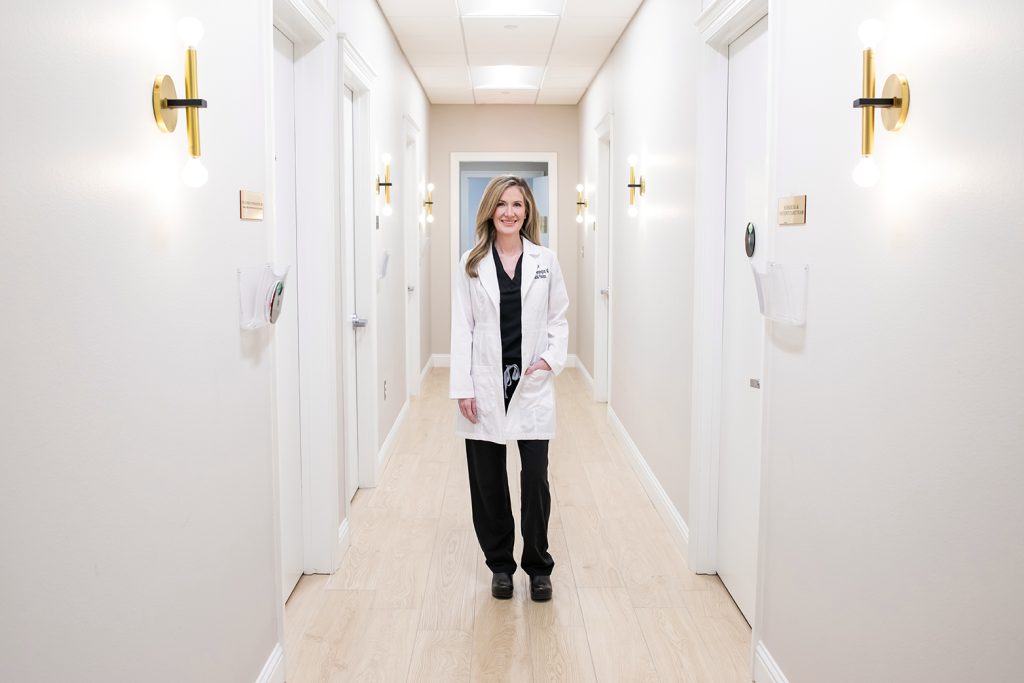 Dr. Lindsey Pennington, founder and surgeon at Pennington Facial Plastics, has built a career around precision. At home, she is learning the beauty of presence.
There is a small pause between Dr. Lindsey Pennington’s two worlds, and it happens before she enters her home.
At the end of a workday, Lindsey pulls in, turns off the car and waits. Sometimes for five minutes. Sometimes ten. She finishes an email, scrolls for a moment on her phone, sends a message to a friend—anything that allows the highly focused brain she has depended upon all day to begin changing gears. Because on the other side of the door are two children and a husband who do not need Dr. Pennington. They need Mommy and Lindsey.
That distinction has taken some practice. “There was a time when I would come home and start directing orders, then expect my home life to work like it does in the OR,” Lindsey admits. Homework. Showers. Bedtime. Tomorrow’s schedule. She can look at a clock and calculate exactly how many minutes remain for each task. It is the surgeon in her—the woman trained to anticipate, organize, execute and account for every detail.
Then her husband, Dr. Andrew Larson, would gently interrupt. “That sounded like Dr. Pennington,” he would say. “That didn’t sound like Mommy.” And she knew exactly what he meant.
For a woman whose professional life has been shaped by precision, excellence and an almost relentless drive toward improvement, Lindsey Pennington is learning something important in this season of her life: Not everything valuable needs to be perfected. Some things simply need to be enjoyed.
If her name is familiar well beyond North Louisiana, there is good reason. Patients travel to Pennington Facial Plastics from across the country and beyond, placing extraordinary trust in the surgeon whose hands will change the face they see in the mirror. Yet Lindsey is careful about that trust.
Her consultations have gradually expanded to two hours because, she says, she cannot know enough about a person in a brief appointment. She wants to understand not simply what a patient hopes to change, but why. She watches how carefully they have prepared, what questions they ask and whether the relationship between surgeon and patient can sustain the vulnerability of surgery. “This isn’t just a sales job,” she explains. Sometimes the most responsible answer is no.
That discernment has come with experience—and with learning to trust something Lindsey jokingly calls her “spidey sense.” Her intuition, she says, serves her as a surgeon, a business owner and a mother. Over time, she has learned that ignoring it usually costs her more than listening to it.
Perfectionism is woven deeply into Lindsey’s personality. She sees what could be better. She notices details. She pushes herself and the people around her. For years, she thought that meant she should be able to make almost anything work—with employees, systems, even relationships. If something failed, her first instinct was often to ask what she should have done differently.
Eventually she learned that every person does not belong on every team, every patient is not the right fit for every practice and every disappointment is not evidence of personal failure. “Mistakes are feedback,” she says. Her philosophy is simple: learn from them, adjust and do not keep making the same one.
 That combination of science, creativity and curiosity was cultivated long before medical school. Lindsey did not grow up as the privileged daughter of two established physicians. She grew up watching her parents become physicians.
Her mother had been a calculus teacher. Her father had a Ph.D. in geriatric psychology. While Lindsey and her brother were young, both parents entered medical training, and the family moved for rotations, internships and residencies. The journey to her parent’s career goals wasn’t always easy, and there were times when they all worked together to cover expenses. In New Orleans, her parents supplemented the family income by making jewelry and selling it. Lindsey and her brother were part of the enterprise, counting the day’s cash into categories—rent, food, expenses. Entrepreneurship was not something she studied later. It was something she lived from an early age.
So was medicine. In fact, one of Lindsey’s favorite childhood memories now seems like an early glimpse of the surgeon she would become. While the family was living in New Orleans, her father came across a small alligator that had been struck by a car, and rather than simply leaving it there, he brought it home. Lindsey’s mother was completing pathology rotations at the time, so what followed was perhaps perfectly normal in the Pennington household: a backyard anatomy lesson. Together, they examined the alligator, exploring its organs and even discovering crawfish in its stomach.
Lindsey laughs at the memory now. No wonder she became a surgeon. In her childhood home, curiosity was encouraged. Art was encouraged. Science was not intimidating or sterile; it was something to explore. “I’ve always been both,” Lindsey says of art and science.
Today those two sides meet in her work. Anatomy and training give her structure and discipline. But artistry allows her to envision beauty and possibility. The same balance exists at home.
Lindsey and Andrew have been together since 2002—a journey that began in college at Tulane, then medical school, residency, careers and children. They were married for ten years before becoming parents and spent portions of their medical training living apart. Those years were not always easy. In fact, Lindsey is refreshingly honest in her reflection of marriage. “We have been through things you could get divorced over,” she says. “And we continually choose us.”
Their marriage, she says, has required work, communication and an intentional decision to keep choosing one another. They have made counseling part of that work, even rearranging Lindsey’s schedule to protect regular time for it. She compares the practice of showing up for counseling to going to the gym. A strong relationship still needs exercise. “We have good, healthy muscles now,” she says. “I don’t want those muscles to go away.” Working together has added another layer.
Andrew serves as the anesthesioligist at Pennington Facial Plastics, and, on days away from the operating room, functions as a financial and operational partner in the practice.
At home, however, his wisdom often appears in quieter ways. “He doesn’t talk a lot,” Lindsey says. “And when he talks, it’s worth listening to.” He understands how she receives information. He knows when she is overwhelmed. He recognizes when the intensity that makes her excellent in surgery has followed her through the door.
Together they have learned to divide family responsibilities according to where each functions best. Mornings belong largely to Lindsey. She schedules her first patient later so she can have breakfast with the children while everyone is rested. They talk about the day ahead without the urgency of work pressing into the room.
Evenings are different. Andrew has more patience for the mechanics of bedtime, so he handles much of it. Once teeth are brushed, pajamas are on and the tasks are finished, it is Lindsey’s cue to step in and be Mommy with bedtime stories and individual time with each child. She lies beside them–no timer, no checklist, and no instructions. Just conversation. “I can just be Mommy,” she says.
Perhaps nowhere did Lindsey understand that need for presence more clearly than during a month her family spent in Italy. After an exceptionally difficult season in business, she was depleted. Andrew, knowing his wife well enough to understand that an instruction to “take time off” might only make her resist, approached the problem differently. He showed her the numbers. Her student loans were paid. Their family was secure. She had permission—not from him, but from the reality in front of her—to pause. So the family went to Italy. They rented a small apartment. Lindsey went to the grocery store. She stayed largely away from social media. She ate pasta. She spent ordinary days with her children. “I felt like I got to know my kids better,” she says. She came home restored—and with a clearer understanding of what she wanted life to hold.
 Interestingly, the future Lindsey and Andrew are building does not look more glamorous. It looks more grounded. The family has taken on a small farm. There are cows now, with chickens and a vegetable garden in the plans. Lindsey is learning to plant, grow things and harvest from ground to table. Andrew, whose South Louisiana family has deep farming and cooking roots, finds joy in returning to those traditions. His parents have moved into the home as part of a multigenerational family.
Their children cook. They are learning responsibility. Lindsey’s daughter has an art room where mess is welcome because creativity matters more than keeping the markers capped. Lindsey never planned the homestead. Andrew did. And after years in which so much of their family life revolved around her medical training, her practice and the demands of her career, Lindsey loves that this chapter reflects something that brings him joy.
Maybe that is what success looks like now. Not doing everything. Knowing what deserves you. Lindsey has even begun narrowing portions of her practice, recognizing that growth for growth’s sake can dilute what she values most: being personally present with her surgical patients. Andrew reminded her that surgery was always the thing she loved. And if she ever changed her mind about the focus on surgery? She could build again. “You can put me in any city anywhere,” Lindsey says, “and I know that I can do this.”
There is confidence in those words, but it is a different confidence than the kind that comes from believing nothing will go wrong. Lindsey knows things go wrong. She has bad days. She cries. She worries. She gets tired. She makes mistakes. She is human—and she wants people to know it.
What has separated her, she believes, is not some extraordinary immunity to fear or failure. It is showing up anyway.
Near the end of our conversation, we asked Lindsey whether, after all these years of education, training and building a practice, she still looks forward to coming to work.
“Absolutely.” Then we asked about home. The answer came just as quickly. She cannot wait to hear what happened at school. She wants the stories, the details, the funny things she missed while she was working. And when the kids were away for sleep-away summer camp, Lindsey and Andrew searched the parent portal for a glimpse of the fun the kids were having. Their lives fascinate her. These little humans, as she calls them, are growing faster than she imagined.
Tomorrow, patients will once again place their trust in Dr. Lindsey Pennington. She will study faces. Make decisions. Anticipate complications. Notice details others might miss. She will be exacting. She will be Dr. Pennington.
And then, eventually, she will take off the white coat. She will pull into her garage, sit for a few minutes, and when she walks through the door, she will practice another kind of excellence entirely. The kind that asks her to put down everything else, listen to a story, and simply come home.